
Power-Time's standard minimum order quantity (MOQ) for standard two-way radio accessories, including remote speaker microphones (RSMs), is 100 pcs, with a production lead time of about 3–5 weeks based on quantity. OEM/ODM orders are quoted separately: connector type, artwork approval and schedule are confirmed per project by our sales team. For utility and mixed-radio fleets, the practical approach is one planned annual batch: separate standing spares from project quantities, consolidate radio models where possible, then work backwards from the date stock must be on the shelf.
| Question | Answer |
|---|---|
| What is the standard MOQ? | 100 pcs for standard two-way radio accessories, including standard RSMs |
| What is the standard production lead time? | About 3–5 weeks, based on quantity |
| Does the 3–5 week window apply to customized orders? | No. OEM/ODM MOQ, cost and schedule are confirmed per project |
| Is a "shoulder speaker microphone" the same as an RSM? | Yes. It is another name for the same accessory; Power-Time lists it as a remote speaker microphone |
| What can be customized? | Connector type, cable length, logo, packaging format, labels and barcodes |
| Can one RSM cover a mixed Motorola fleet? | Yes. The PTE-1308 M01 is listed for more than 40 Motorola radio models, including CP200, DP1400 and CP040 |
| What ratings apply? | PTE-1308 M01 is IP54; other Power-Time RSM models are rated IP55 and IP67. Power-Time states CE certification across its accessories |
A shoulder speaker microphone is a two-way radio accessory that combines a loudspeaker, a microphone and a push-to-talk (PTT) button in one unit clipped near the shoulder or lapel, so the radio can stay on the belt. It is the same product as a remote speaker microphone (RSM). Depending on the industry and the region, buyers also call it a shoulder mic, fist mic, speaker mic or speaker microphone. Power-Time uses "remote speaker microphone (RSM)" and "speaker microphone" in its product catalogue; this guide uses both wordings so that whichever term your team searches for, the specifications and ordering terms below are the same.
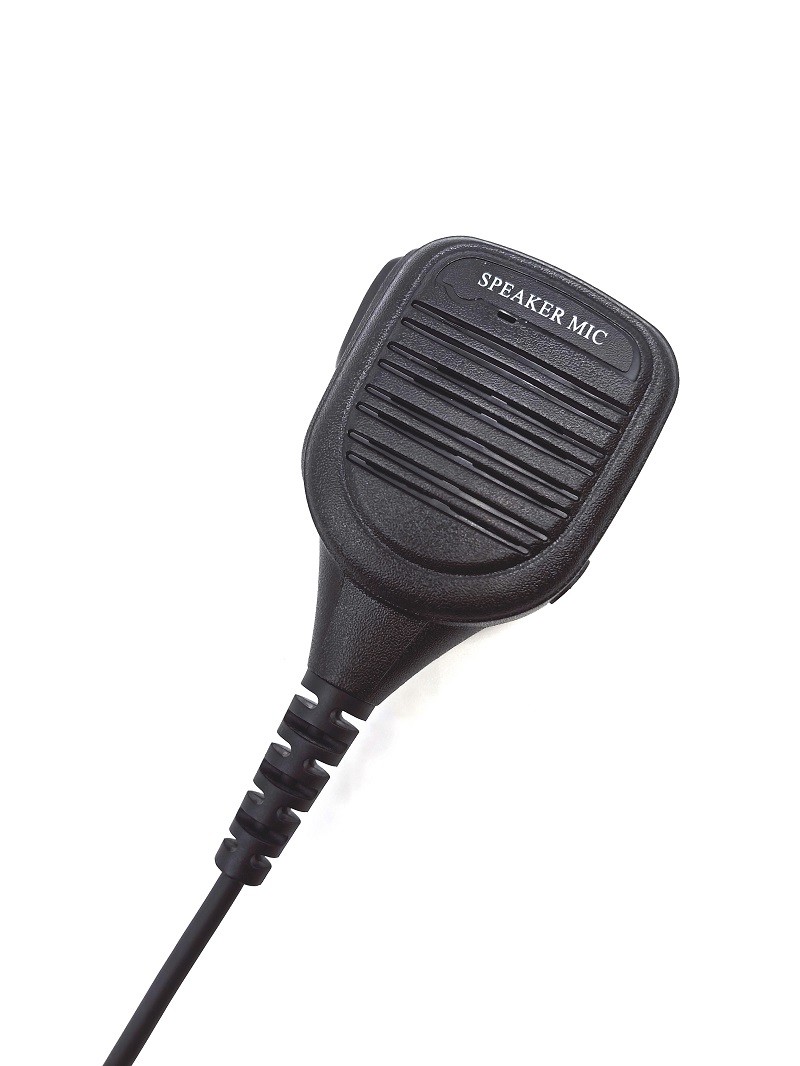
A remote speaker microphone (RSM) — also called a shoulder speaker microphone, shoulder mic or fist mic — keeps the radio on the belt and the speaker close to the ear.
Utility crews often work in noise levels near or above the 85 dBA 8-hour recommended exposure limit (REL) defined by NIOSH, which is one reason an RSM positioned close to the ear matters for received audio (CDC/NIOSH).
The standard MOQ is 100 pcs for standard accessories. A large municipal or utility fleet often consumes close to that number in a year of replacements, so it becomes a natural annual batch. A smaller department may need longer than a year to use 100 units; in that case buyers typically consolidate several radio models, sites or departments into one purchase order, or fold the accessory order into a wider procurement that also covers batteries and chargers. Confirm the final model mix with our sales team before the order is placed.
An MOQ also sets a minimum batch that stores must manage deliberately. Once 100 pcs are committed, define an issue-and-replenish rhythm — which depot holds the stock, which models are released first, and at what remaining quantity a new order is triggered — rather than leaving the cartons in a corner. One planned batch gives stores a cleaner inventory position than several unplanned small requests.
Standard accessories take about 3–5 weeks of production time, based on quantity. This is comfortable for planned replenishment and uncomfortable for emergencies, so treat the window as a scheduling input: set the order date backwards from the date stock must be on the shelf, then add a buffer for internal approval and inbound shipping.
OEM/ODM projects are different. Per the Power-Time FAQ, OEM/ODM lead time is set according to the project details. Artwork approval, connector tooling and packaging proofing all happen before production, so confirm the schedule with the business team before fixing a delivery date in a budget.
Illustrative planning dates only — confirm the production window with sales before committing:
| Stock needed on shelf | Working back 3–5 weeks plus approval/shipping buffer | Place the order by |
|---|---|---|
| 1 June, before storm season | 5 weeks + 1–2 weeks buffer | Mid-April |
| 1 September, before a scheduled inspection round | 5 weeks + 1–2 weeks buffer | Mid-July |
| 1 November, for new-vehicle fit-out | 5 weeks + 1–2 weeks buffer | Mid-September |
Start with three numbers the maintenance office already owns: the number of crews, the number of radios per crew, and the radio models installed across the fleet. Then separate two quantities that have different justifications:
Illustrative example only: 30 crews × 2 radios = 60 active RSMs; at a 15% annual replacement rate that is 9 standing spares; add 20 units for a vehicle fit-out and the plan is 29 units. That is below the 100 pcs MOQ, so the department would consolidate with another site, add a second radio model family to the same order, or combine the RSMs with batteries and chargers in one procurement. Use your own failure rate, not the example figure.
Keeping standing spares and project quantities separate makes the batch easier to justify, because each line has a reason attached. It also shows which radio models dominate the installed base — the information needed to reduce SKUs.
The PTE-1308 M01 IP54 Heavy Duty Speaker Microphone is designed for mixed Motorola fleets. Its product page lists compatibility with more than 40 Motorola models, including CP200, DP1400, CP040, CP150, EP450, GP300, PR400, P165 and P185, among others. One speaker microphone model covering several radio generations means fewer SKUs for stores to track, fewer connector variants to stock, and a single spare part across older and newer radios.

The connector is the part that determines radio compatibility: one RSM model can serve more than 40 Motorola radio models.
| PTE-1308 M01 specification | Value |
|---|---|
| Ingress protection | IP54 (dust-protected, splash-proof; IEC 60529) |
| Cable | 5.5 mm heavy-duty cable |
| Clip | 360° rotatable stainless-steel back clip |
| Audio | Quality speaker and microphone; 3.5 mm earpiece jack |
| Speaker | Ø45 mm, 8 Ω ±15% @ 1 kHz, 92 ± 3 dB at 1 W / 0.5 m |
| Speaker power | Rated input 1.0 W, maximum input 1.5 W |
| Microphone | Ø9.7 × 6.5 mm, sensitivity −56 ± 2 dB |
| Packaging | Each box contains one speaker microphone |
Within the wider Remote Speaker Microphones range, Power-Time also offers IP55 and IP67 models, wired and Bluetooth options, and models with an emergency button. For connector-level questions, see the Two-Way Radio Mic Compatibility Guide.
View the PTE-1308 M01 IP54 Heavy Duty Speaker Microphone
Utility stores teams usually need packaging that survives an internal stores system, not packaging that sells. Power-Time supports OEM/ODM customization of connector type, cable length, logo, packaging format and other details. For a mixed fleet, connector customization is often the most valuable item: it determines which radio models a single order can serve.
Typical requests include:
| Request | What to specify |
|---|---|
| Connector / model mix | Radio model list and quantity per model |
| Packaging format | PE bag for cost-efficient shipping, or box for retail-ready / project handover |
| Printed information | Department name, asset label, model callout, barcode scheme |
| Branding | Logo or artwork files in a usable format, and where the logo should sit |
| Timing | Date the goods must be in hand |

Standard packing shown above is the starting point for OEM/ODM changes to box format, labels, barcodes and logo placement.
State whether the packaging is for internal stores or for a project handover — that changes how much printed information belongs on the carton. Customization costs, artwork approval rounds and the exact production schedule require business confirmation before the order is placed; approvals are easier to absorb before the production window opens than inside it.
Send the following in one message so the quotation covers everything in a single pass:
Our sales team will confirm the MOQ, lead time and customization scope for a batch plan you can put into next year's budget. Samples and quotations are available on request — contact Power-Time to start an inquiry. Whether your team calls it a shoulder mic, a shoulder speaker microphone or an RSM, the radio model list is what determines the correct connector.
A: The standard MOQ is 100 pcs for standard two-way radio accessories, including standard remote speaker microphones. Smaller departments often reach that figure by combining several radio models, sites or accessory categories into one order; larger fleets frequently plan around it as a natural annual spare level.
A: Standard two-way radio accessories take about 3–5 weeks of production time, based on quantity. Place the order against a known date — storm season, an inspection round or a vehicle fit-out — rather than against immediate need, and allow extra time for internal approval and shipping.
A: No. The 3–5 week window applies to standard accessories. For OEM/ODM projects, the MOQ, customization cost, artwork approval steps and production schedule are confirmed by our business team according to the project details before the order is placed.
A: Yes. Shoulder mic, fist mic, speaker mic, speaker microphone and remote speaker microphone (RSM) all refer to the same clipped speaker-and-microphone accessory for a two-way radio. Power-Time uses "remote speaker microphone (RSM)" and "speaker microphone" in its catalogue, and both the MOQ and the lead time above apply to the same standard accessory range.
A: Yes. Power-Time supports OEM/ODM customization of connector type, cable length, logo, packaging format and other details. Send your radio model list, quantities by model, artwork, packaging requirements and required delivery date; our team will confirm the cost and schedule before production starts.
A: Yes. The PTE-1308 M01 is listed for more than 40 Motorola models including CP200, DP1400 and CP040. Standardizing on one RSM family reduces the number of SKUs and connector variants that stores must track, which makes an annual batch plan easier to administer.

